Attachment Therapy for Rebuilding Connection After Conflict
Conflict can crack the surface of a relationship in obvious ways, through shouting, distance, stonewalling, betrayal, or repeated arguments about the same painful issue. What often goes less noticed is the deeper rupture underneath. After a serious conflict, many people are not just angry. They are disoriented. They no longer feel safe reaching for the person who once felt like home.
That is where attachment therapy becomes especially useful. It does not treat conflict as a simple communication problem, even when communication clearly needs work. It looks beneath the argument and asks a harder question: what happened to the bond? Once trust is strained, people do not merely disagree about chores, parenting, money, sex, or in-laws. They begin to protect themselves. One partner pursues, protests, and presses for reassurance. The other withdraws, shuts down, or grows brittle and defensive. Both people suffer, and both often feel misunderstood.
In clinical practice, this pattern is common. A couple arrives saying they fight about “everything,” but after twenty minutes it becomes clear they are really fighting about whether they matter to each other. A parent and adult child say they need “better boundaries,” but what surfaces is years of inconsistency, grief, and longing for care that was not reliable. Even close friends can land here after a betrayal or a season of repeated disappointments. Attachment wounds are not limited to romance. They show up anywhere connection is important and vulnerability has become risky.
Attachment therapy offers a path back, not by rushing people into forgiveness, and not by pretending every relationship can or should be repaired, but by helping them understand the bond, regulate the nervous system, and create enough safety for real repair.
What attachment therapy is really addressing
At its core, attachment therapy focuses on how people seek closeness, respond to distress, and protect themselves when connection feels threatened. These patterns usually develop early, but they remain active throughout life. A person who learned that comfort was unpredictable may become hypervigilant in conflict. Another who learned that feelings were unwelcome may go numb or disappear emotionally the moment tension rises.
After conflict, these old adaptations tend to intensify. The present argument pulls in the past. A delayed text reply feels intensive trauma therapy like abandonment. A raised voice feels like danger. A request for accountability feels like humiliation. People often know, intellectually, that their partner or family member is not their parent. Their body does not always know that. This is one reason attachment therapy frequently overlaps with trauma therapy. Not every relational rupture is traumatic, but many conflicts reactivate earlier experiences of fear, neglect, instability, or emotional loneliness.
This is also why talk alone is not always enough. If someone’s nervous system is flooded, they may agree with insight in session and still react the same way at home that night. The body needs help catching up. That is where somatic therapy can be a strong companion to attachment work. Tracking breath, posture, tension, pacing, and the impulse to move toward or away from someone can reveal the attachment story in real time. A clenched jaw, a frozen chest, eyes fixed on the floor, a body angled toward the exit, these are not side notes. They are part of the conversation.
When conflict becomes a rupture
Not every disagreement damages attachment. Healthy relationships can absorb a surprising amount of friction. The difference lies in whether the conflict ends with some form of repair. Repair may be awkward, incomplete, or delayed, but it restores a basic message: we are still connected, your feelings matter, and we can find our way back.
Rupture begins when that message is missing or repeatedly contradicted. The conflict lingers in the body and in memory. People replay it, scan for signs it will happen again, and reorganize their behavior around self-protection. A few patterns show up again and again in attachment-focused work:
- protest behavior, such as repeated texting, interrogation, criticism, or demands for reassurance
- withdrawal, including silence, emotional flatness, avoidance, or leaving the room without re-engaging
- defensive counterattack, where shame quickly converts into blame
- pseudo-repair, where people apologize to end tension but never address the injury itself
- collapse, in which one or both people feel hopeless and stop trying
These responses are easy to judge from the outside. In the room, they make more sense. Protest often masks panic. Withdrawal often masks overwhelm. Counterattack often protects against unbearable shame. Collapse often follows a long season of trying without results. Attachment therapy does not excuse harmful behavior, but it does translate it. That translation matters because shame rarely creates change. Understanding, paired with accountability, often does.
Why insight alone does not repair connection
Many people seeking help are bright, articulate, and deeply self-aware. They can name their patterns. They can connect current reactions to childhood experiences. They can even predict the next fight before it happens. Yet the cycle still repeats. That can feel demoralizing.
The reason is simple. Attachment injuries live in procedural memory as much as explicit memory. People do not just remember them as stories. They carry them as expectations. “If I need too much, I’ll be rejected.” “If I show weakness, I’ll be controlled.” “If I stay present during conflict, I’ll get hurt.” Those beliefs are reinforced through sensation and repetition. They shift through new relational experiences, not just new ideas.
A therapist using attachment therapy pays close attention to these live moments. When one person glances away after a vulnerable statement, the therapist may slow the process and explore what happened inside. When a partner reaches out and the other stiffens, that response becomes clinically important. When someone says, “I don’t know why I’m so angry,” the therapist often listens for the softer feeling underneath, fear, grief, longing, shame, or disappointment.
This is why good attachment work often feels slower than clients expect at first. It is not stalling. It is building the conditions for something more durable than a temporary truce.
The role of the nervous system in post-conflict repair
After conflict, people often focus on content. Who said what. Who started it. Which facts were omitted. These details matter, especially where trust has been damaged, but they do not tell the whole story. The body’s state shapes what each person can hear, feel, and express.
If one partner is in fight mode, their speech may sharpen and their attention narrows around threat. If another is in freeze, they may look calm while internally feeling detached, foggy, or unable to find words. Telling either person to “just communicate better” misses the problem.
Somatic therapy helps here because it gives clients a way to notice activation before it turns into harm. Sometimes the first task is surprisingly basic: feel both feet on the floor, exhale longer than the inhale, orient to the room, track the urge to interrupt, name the rising heat in the face or chest. These are not gimmicks. They are practical interventions that restore a little choice.
In couples or family work, I have seen dramatic shifts from very small adjustments. A father who always answered his adult daughter’s hurt with logic learned to pause, uncross his arms, and say, “I can feel myself getting defensive, but I want to stay here.” That sentence changed the session. Not because it solved the past, but because it interrupted an old attachment script. His daughter no longer had to escalate in order to prove there was pain in the room.
Movement therapy can also be relevant, particularly for clients who struggle to identify emotion verbally. Some people organize their inner world more clearly through gesture, walking, posture, or intentional movement than through direct conversation. In attachment repair, this might look like noticing how close someone can sit before they tense, exploring what happens when they turn toward rather than away, or using paced movement to discharge activation after discussing a painful event. The body can reveal where connection still feels dangerous and where safety is beginning to return.
Conflict often awakens older grief
One of the more overlooked elements in relational repair is grief. Not just grief after death, but grief over what was missed, broken, or never received. Grief counseling principles are highly relevant here. When people fight intensely about present-day disappointments, they are often also grieving older losses, the attuned parent they did not have, the dependable partner they hoped for, the easy friendship that existed before betrayal, the version of family they wanted for their children.
This grief is easy to cover with anger because anger feels mobilizing. Grief slows people down. It exposes tenderness. It asks them to admit that something important mattered and may never be restored exactly as it was. In therapy, that can be the turning point. A partner who has spent months attacking finally says, “I don’t know how to forgive that you were not there when I needed you.” Another says, “I am not only mad. I am heartbroken that you no longer trust me.”
Those moments require careful handling. If the therapist moves too quickly toward problem-solving, the deeper repair gets bypassed. If the therapist stays only with pain and never moves toward structure, clients can feel flooded. The work is to help people grieve what happened while also asking what kind of relationship is still possible.
What repair actually looks like in practice
Repair is not a single apology or one powerful session. It is a series of experiences in which people discover that truth can be spoken without the bond collapsing, and that hurt can be acknowledged without immediate retaliation.
A useful repair process usually includes several elements. First, the injury must be named plainly. Vague language keeps people stuck. “Things have been hard” does not land like “When you left in the middle of that argument and ignored me for two days, I felt abandoned.” Second, the impact has to be heard before intent takes over. Intent matters, but it often arrives too early. Third, the person who caused harm needs to take responsibility for the behavior, not only for the other person’s reaction. Fourth, both people need support tolerating the vulnerability that follows. This is often the most difficult part. After accountability comes uncertainty. Will I be forgiven? Will I be hurt again? Will closeness return?
In secure relationships, this process can be messy and still effective. In highly distressed relationships, it often needs containment. That may mean structured dialogues in session, time-limited conversations at home, or explicit agreements about stopping before the interaction becomes destructive.
One couple I worked with had a reliable cycle. She would raise a concern late at night, already exhausted and hurt. He would hear criticism, shut down, and sleep on the couch. By morning both were colder. We did not begin with childhood histories, although those became relevant later. We began with timing, body cues, and the exact moment each person lost access to the other. Once they could identify the early signs, her voice tightening, his shoulders locking, the repair process became more realistic. She learned to say, “I need a response, not a solution.” He learned to say, “I am getting flooded. Give me twenty minutes and I will come back.” The important part was not the script. It was that he actually came back. Repeatedly. Reliability repaired what language alone could not.
Grief counselingAttachment therapy is not the same as staying together
This point deserves clarity. Rebuilding connection does not always mean preserving the relationship in its current form. Sometimes attachment therapy helps people reconnect well enough to co-parent respectfully after separation. Sometimes it helps an adult child maintain contact with a parent while loosening the fantasy that the parent will become someone different. Sometimes it helps a couple recognize that the bond cannot safely continue because abuse, coercion, or chronic deception remain active.
Good attachment work is not sentimental. It does not pressure clients to prioritize closeness over safety. Where there has been domestic violence, intimidation, stalking, threats, or severe manipulation, the first task is not mutual vulnerability. It is protection, stabilization, and clear boundaries. In these cases, trauma therapy may need to take priority, with attachment repair considered only if and when safety is real.
That distinction matters because attachment language can be misused. A controlling person may frame their possessiveness as “just needing reassurance.” A chronically avoidant partner may use therapeutic insight to sound reflective without becoming more accountable. A skilled therapist watches for these distortions and keeps the work anchored in behavior, not just emotion.
How people begin to feel safer again
Safety after conflict is built through consistency more than intensity. Grand gestures can feel moving, but they rarely hold unless daily behavior changes with them. Most clients want a dramatic breakthrough. More often, trust returns through ordinary moments. A hard conversation that ends without contempt. A truthful answer given promptly. A promise kept on a Tuesday. A hand reached out and not rejected. A pause taken before old habits take over.
There are a few practices that tend to support this process well:
- slowing conflict down enough to notice escalation before it becomes damage
- naming primary emotions, such as fear or sadness, instead of leading only with anger
- making repair attempts specific, behavioral, and timely
- developing body-based regulation skills so difficult conversations stay tolerable
- repeating new patterns often enough that they become believable
None of these are flashy. All of them work better than dramatic speeches that fade by the next argument.
The pace of repair is rarely equal
A common frustration in attachment therapy is asymmetry. One person may be ready to reconnect while the other remains cautious for months. One may feel relieved after an honest apology while the other continues to have bodily reactions that seem “out of proportion.” This does not necessarily mean the therapy is failing. Trust and nervous system recovery do not move on command.
The person who caused injury often wants a clear finish line. They may say, “I said I was sorry, what else am I supposed to do?” The answer is usually some version of this: remain accountable long enough for your consistency to become credible. If the injury happened over time, the repair will also take time.
On the other side, the injured person may need help distinguishing between understandable vigilance and perpetual punishment. Staying connected while never allowing the other person to matter again is not repair. It is proximity without intimacy. A therapist may gently ask whether self-protection has become so rigid that no new experience can register.
This is where judgment matters. There is no universal timeline. Some ruptures soften within weeks. Others take a year or more, especially if the conflict reopened developmental trauma, grief, or longstanding family wounds.
Working with individuals as well as pairs
Although attachment therapy is often associated with couples, individual therapy can be just as powerful. Sometimes a relationship is too volatile for joint sessions at first. Sometimes the other person will not participate. Sometimes the most important work is helping one client understand their relational template so they stop recreating the same painful dynamic across different relationships.
In individual treatment, the therapy relationship itself becomes meaningful. The client notices what happens when they need help, set limits, feel disappointed, or fear being misunderstood. These moments are not side effects. They are part of the work. A client who expects abandonment may test reliability unconsciously. A client who expects intrusion may hide strong feelings until resentment builds. Gentle, well-boundaried consistency from the therapist can create a new attachment experience, one that later supports repair in the client’s outside relationships.
This is also where modalities can integrate well. Trauma therapy may help process earlier experiences that are driving current reactivity. Somatic therapy can restore regulation and embodied awareness. Movement therapy may help clients who feel trapped in freeze or disconnected from emotion. Grief counseling can support mourning around relationships that changed irreversibly. Attachment therapy provides the relational frame that ties these pieces together.
What to look for in a therapist
The term attachment therapy can mean different things depending on the clinician’s training. Technique matters less than clinical depth. A useful therapist should understand conflict cycles, developmental history, nervous system regulation, and the difference between repairable rupture and unsafe dynamics. They should be able to work with emotion without becoming vague, and with accountability without becoming punitive.
Experience also helps. Relational conflict can become chaotic quickly in the room. A therapist needs to know when to slow things down, when to interrupt, when to ask for precision, and when one person is becoming too activated to continue productively. The best work often feels steady rather than dramatic.
If you are considering this kind of therapy, it is reasonable to ask how the therapist approaches high-conflict patterns, trauma histories, and situations where one person withdraws while the other pursues. Their answer should sound grounded, not formulaic.
Reconnection is built, not declared
After serious conflict, people often want certainty. They want to know whether the bond can be restored, whether trust will return, whether closeness will feel natural again. Attachment therapy does not offer guarantees. What it offers is a disciplined way of working with the realities beneath conflict: fear of loss, longing for responsiveness, protective habits that once made sense, and the body’s stubborn memory of hurt.
When the work goes well, connection does not reappear as a sudden feeling. It is rebuilt through many moments of tolerable honesty. The angry partner discovers they can ask directly for comfort without escalating. The withdrawn partner learns they can stay present without losing themselves. A parent finally hears the adult child’s pain without defending the whole family story. Two people speak about betrayal and remain in the room together, breathing, listening, and telling the truth.
That is the heart of attachment repair. Not perfection. Not endless processing. Not quick forgiveness. A relationship becomes livable again when people can turn toward each other with more honesty than fear, more steadiness than reflex, and enough safety that vulnerability is no longer treated as a threat.
Spirals & Heartspace
Name: Spirals & Heartspace
Address: 534 W Gentile St, Layton, UT 84041
Phone: (385) 301-5252
Website: https://spiralsandheartspacehealing.com/
Hours:
Sunday: Closed
Monday: 9:30 AM – 7:00 PM
Tuesday: 9:30 AM – 7:00 PM
Wednesday: 9:30 AM – 7:00 PM
Thursday: 9:30 AM – 7:00 PM
Friday: 9:30 AM – 7:00 PM
Saturday: Closed
Open-location code / plus code: 326F+5G Layton, Utah, USA
Coordinates: 41.0604503, -111.9762128
Map/listing URL: https://www.google.com/maps/place/Spirals+%26+Heartspace/@41.0604503,-111.9762128,766m/data=!3m2!1e3!4b1!4m6!3m5!1s0x875303311f1d4d1b:0xc6859e5e3fceafe2!8m2!3d41.0604503!4d-111.9762128!16s%2Fg%2F11x781dbvb
Embed iframe:
Socials:
Instagram: https://www.instagram.com/spiralsheartspace/
LinkedIn: https://www.linkedin.com/company/spirals-and-heartspace-pllc
TikTok: https://www.tiktok.com/@spiralsheartspace
X: https://x.com/SpiralsHea61786
YouTube: https://www.youtube.com/@SpiralsHeartspace
The practice is led by Ande Welling, a licensed clinical mental health counselor with training in dance/movement therapy, somatic work, EMDR, trauma care, relational neuroscience, and embodied attachment.
Listed services include therapy, coaching, consultation, authentic movement, trauma therapy, somatic therapy, grief counseling, movement therapy, and attachment therapy.
The practice serves adults who want a deeper body-aware approach to trauma, anxiety, depression, grief, burnout, self-abandonment, family patterns, and relationship wounds.
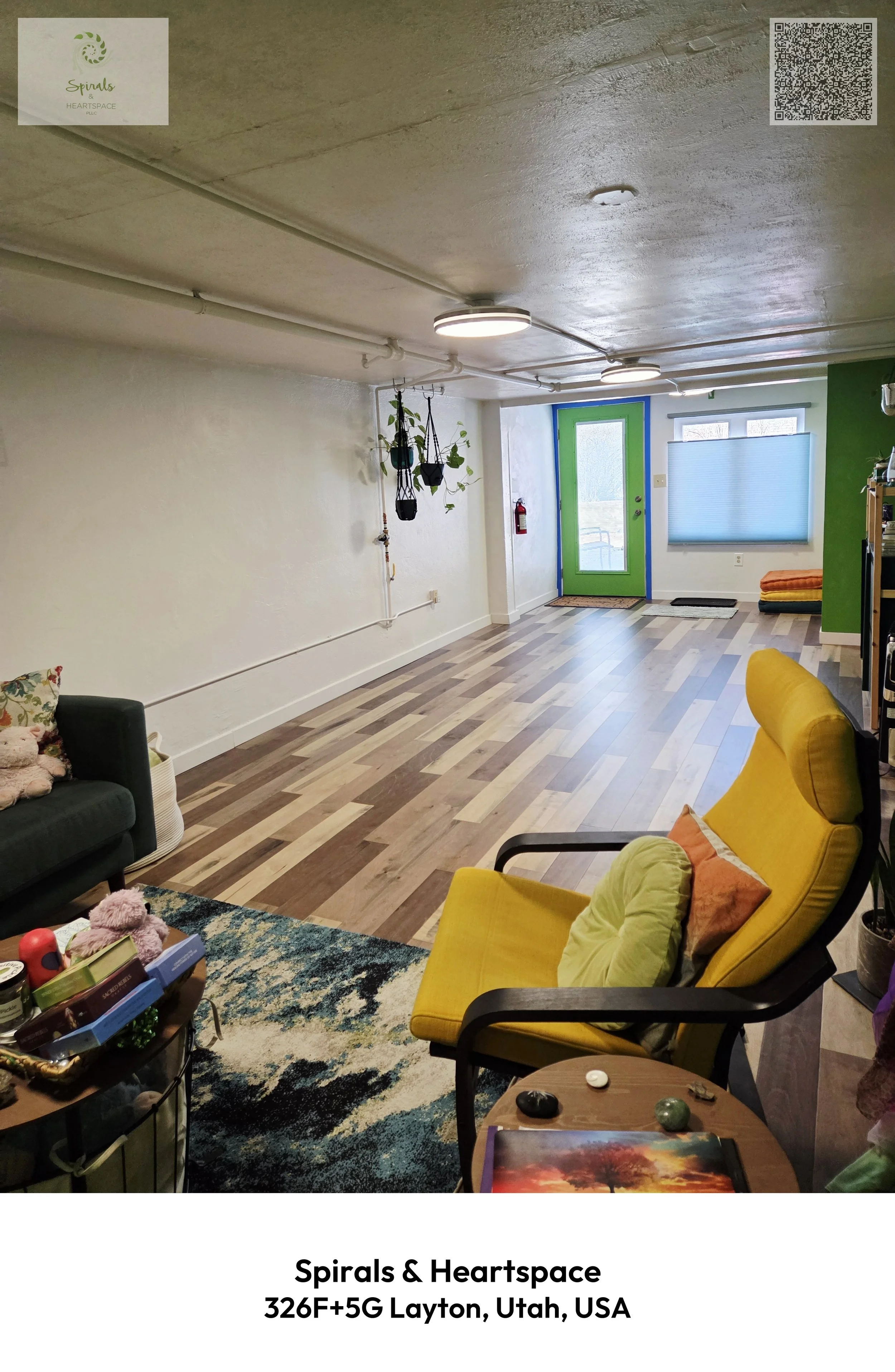
Spirals & Heartspace offers both in-person sessions in Layton and online therapy for clients in Utah.
The practice is locally positioned for clients in Layton, Kaysville, Farmington, Syracuse, Clearfield, Clinton, Roy, Ogden, Bountiful, Davis County, and nearby northern Utah communities.
The office is listed at 534 W Gentile St in Layton, with public listing hours Monday through Friday from 9:30 AM to 7:00 PM.
Prospective clients can call (385) 301-5252 or visit https://spiralsandheartspacehealing.com/ to ask about consultation options, session fit, and scheduling.
The public map listing for Spirals & Heartspace can help clients verify the Gentile Street office before planning an in-person appointment.
Popular Questions About Spirals & Heartspace
What is Spirals & Heartspace?
Spirals & Heartspace is a Layton, Utah psychotherapy and coaching practice offering somatic, trauma-focused, expressive arts, movement-based, and attachment-informed support for adults.
Who is the therapist at Spirals & Heartspace?
The official site identifies Ande Welling as the therapist, coach, movement facilitator, and guide behind Spirals & Heartspace. Listed credentials include LCMHC, BC-DMT, NCC, GL-CMA, BSE, EMDR Trained, and CCTP-II.
Where is Spirals & Heartspace located?
The matching public listing and LinkedIn profile list the address as 534 W Gentile St, Layton, UT 84041.
Does Spirals & Heartspace offer online therapy?
Yes. The official FAQ states that therapy is available in person or through a HIPAA-compliant telehealth platform for clients who live in Utah.
What services does Spirals & Heartspace provide?
Listed services include therapy, coaching, consultation, authentic movement, trauma therapy, somatic therapy, grief counseling, movement therapy, and attachment therapy.
What makes somatic therapy different from traditional talk therapy?
The official Layton page explains that somatic therapy works with body sensations, movement, and physical experience because trauma and emotional patterns can be held in the nervous system, not only in thoughts.
Do clients need dance experience for movement therapy?
No. The official Layton FAQ says no dance training or special physical ability is required, and that movement therapy uses a client’s natural capacity for movement to access emotions and process experiences.
Does Spirals & Heartspace accept insurance?
The official FAQ says the practice does not take insurance directly, but may provide superbills or bill for out-of-network benefits when applicable. Clients should confirm current reimbursement options directly before scheduling.
What are Spirals & Heartspace’s listed hours?
The matching public listing shows Monday through Friday from 9:30 AM to 7:00 PM, with Saturday and Sunday closed. Appointment availability should be confirmed directly.
How can I contact Spirals & Heartspace?
Call (385) 301-5252, visit https://spiralsandheartspacehealing.com/, or use the listed social profiles: https://www.instagram.com/spiralsheartspace/, https://www.linkedin.com/company/spirals-and-heartspace-pllc, https://www.tiktok.com/@spiralsheartspace, https://x.com/SpiralsHea61786, and https://www.youtube.com/@SpiralsHeartspace.
Landmarks Near Layton, UT
Spirals & Heartspace is located on West Gentile Street in Layton, Utah, with in-person therapy available locally and online therapy available for Utah residents. Clients near these landmarks can call (385) 301-5252 or visit https://spiralsandheartspacehealing.com/ to ask about somatic therapy, trauma therapy, movement therapy, grief counseling, attachment therapy, and consultation options.
- 534 W Gentile St — The listed office address for Spirals & Heartspace; clients can use the map listing to verify the office before visiting.
- West Gentile Street — The local street connected with the practice’s Layton office location.
- Downtown Layton — A practical local reference point for clients navigating central Layton.
- Layton Hills Mall — A major Layton shopping landmark and useful orientation point for clients traveling through the city.
- Interstate 15 near Layton — A major northern Utah route that helps clients reach Layton from nearby Davis County communities.
- Layton FrontRunner Station — A transit landmark for clients traveling by commuter rail through Davis County.
- Ellison Park — A local park and community landmark in Layton.
- Great Salt Lake Shorelands Preserve — A major natural landmark west of Layton and a recognizable Davis County destination.
- Hill Air Force Base — A major regional landmark near Layton and Clearfield.
- Kaysville — A nearby Davis County city listed in the practice’s surrounding service area.
- Farmington — A nearby Davis County community included in the broader local service-area language.
- Ogden — A nearby northern Utah city; clients can ask whether online Utah therapy or in-person Layton sessions are the best fit.