Grief Counseling for Coping With Sudden and Unexpected Loss
A sudden loss tears through ordinary life with a force that people often struggle to describe. One phone call, one knock at the door, one moment in traffic or at work, and the world no longer behaves the way it did that morning. The death may come through accident, overdose, suicide, medical crisis, violence, or an event no one saw coming. Whatever the cause, the shock lands in both mind and body. People often tell me the same thing in different words: “I know what happened, but it doesn’t feel real.”
That gap between knowing and feeling is one of the central reasons grief counseling can be so important after unexpected loss. Grief is not simply sadness. In these cases, it often includes trauma responses, bodily dysregulation, fragmented memory, sleep disruption, guilt, anger, confusion, panic, numbness, and a profound rupture in a person’s sense of safety. Standard advice about “stages” or “closure” tends to fall flat because sudden grief rarely moves in a clean line. It surges, stalls, loops back, and changes shape over time.
When people seek grief counseling after an unexpected death, they are not looking for someone to erase pain. They are looking for help surviving it, understanding it, and eventually carrying it in a way that does not consume every waking hour.
Why sudden loss feels different
Expected loss and sudden loss can both be devastating, but they often affect the nervous system differently. When a death follows a long illness, families may already be living with anticipatory grief. They may have had difficult conversations, made practical arrangements, or at least imagined what life might look like afterward. None of that removes suffering, but it can soften the jolt.
Sudden loss usually offers no such preparation. The brain tries to catch up to an event that arrived without warning. That mismatch can leave a person in a highly activated state. It is common to replay details obsessively, to search for a mistake that could have prevented the death, or to become preoccupied with the final minutes, even when facts are incomplete. Some people feel flooded by emotion. Others feel almost nothing for days or weeks and worry that something is wrong with them. Both reactions can be normal.
A spouse whose partner dies in a car accident may spend weeks unable to drive through certain intersections. A parent after an accidental overdose may wake at 3 a.m. Every night, heart racing, as if the body is still waiting for the emergency. A sibling after a suicide may become consumed by questions that have no satisfying answer. These are not signs of weakness. They are signs that grief and trauma have become intertwined.
That is where grief counseling often differs from ordinary support. Friends can bring meals, handle errands, sit quietly, and help with practical burdens. Those gestures matter. But a trained counselor can help a bereaved person make sense of intense reactions that can otherwise feel frightening or isolating.
What grief counseling actually does
Grief counseling provides a structured, compassionate space to process the loss without rushing adaptation or forcing positivity. The work is part emotional, part relational, and often part physiological. A good therapist pays attention not only to what the person says, but also to how they are functioning: Are they eating? Sleeping? Returning to work? Dissociating? Drinking more? Avoiding reminders entirely? Feeling unsafe in their own body?
In practice, grief counseling may involve helping someone tell the story of the loss in manageable pieces, identifying triggers, working with guilt or anger, supporting family communication, and finding ways to stay connected to the person who died without becoming trapped in the moment of death. Many people come in believing they need to “get over it.” More often, the work is about learning how to live alongside grief while restoring enough steadiness to participate in life again.
This is also where clinical judgment matters. Not every grieving person needs intensive trauma therapy. Not every crying spell signals depression. Not every period of numbness requires immediate interpretation. The best counseling meets the person where they are rather than imposing a formula. Some clients need very practical support at first, such as help getting through a funeral, handling anniversaries, or informing children. Others need careful work around flashbacks, panic, or shame. Timing matters. So does pacing.
When grief and trauma overlap
After sudden loss, the nervous system often behaves as though danger is still present. A person may feel jumpy, detached, hypervigilant, or easily overwhelmed by ordinary demands. Crowded stores, hospital smells, sirens, certain songs, or even a particular time of day can trigger intense reactions. Some survivors avoid all reminders. Others cannot stop seeking them.
This overlap is why trauma therapy can be a useful part of grief treatment. Trauma therapy is not a replacement for mourning. It addresses the body and brain responses that keep a person stuck in survival mode. If someone cannot sleep, cannot stop replaying the moment they found the body, or cannot enter the room where the death occurred without panic, trauma-informed care may be essential before deeper grief work can even begin.
An experienced clinician will usually ask practical questions that reveal more than people expect. Can you drive? Are you eating one full meal a day? Do you startle when the phone rings? Do you avoid being alone? Have you had moments of feeling unreal or outside your body? Can you tolerate looking at photos of the person who died, or does that send you into shutdown? These details help distinguish grief that is painful but within expected range from grief that has become complicated by traumatic stress.
The body does not grieve only in words
People often assume counseling is primarily talking. After sudden loss, talking can help, but words are not always enough. Grief lives in the chest, throat, stomach, jaw, breath, and skin. It can show up as dizziness, nausea, exhaustion, shallow breathing, muscle tension, appetite changes, and a startling sense that the body is no longer trustworthy.
Somatic therapy can be especially useful here. Broadly speaking, somatic therapy helps people notice and regulate bodily responses connected to stress, trauma, and emotion. That might sound abstract, but in session it can be very concrete. A therapist may guide a client to track where they feel tightness when they speak about the death, to notice whether their breathing stops at certain points, or to practice grounding methods that reduce overwhelm without suppressing grief.
This is not about “fixing” Grief counseling emotion with breathing tricks. It is about helping a person stay present enough to feel what is there without being swept away by it. For someone whose body goes numb every time they mention the loss, somatic work can gently widen the window of tolerance. For someone who feels panic rise so fast they cannot think, body-based regulation can create just enough space for reflection.
Movement therapy can also play a role, especially for clients who feel trapped by restlessness, frozen states, or repeated activation. Grief often has a motor component. Some people pace constantly. Others feel glued to the couch. Purposeful movement, used skillfully, can help discharge tension, reestablish rhythm, and reconnect people to physical presence. That might involve structured movement in therapy, walking rituals, stretching paired with emotional processing, or other forms of embodied expression. The point is not performance. The point is restoring a sense that the body can move through pain rather than only brace against it.
Attachment wounds often reopen after loss
Sudden death does not happen in a vacuum. It lands inside a person’s existing attachment history, relationship patterns, and previous losses. If the person who died was a primary source of safety, regulation, or identity, the loss can shake the foundations of daily functioning. A husband who handled finances, a mother who was the family’s emotional center, an adult child who checked in every morning, these roles matter as much as titles.
Attachment therapy can be valuable when the grief activates older fears of abandonment, instability, or unworthiness. Some clients become intensely afraid that other loved ones will die too. Some become clingy, withdrawn, or angry in relationships they previously managed well. Others feel ashamed of how much they need support, especially if they were the “strong one” before the loss.
In therapy, these patterns are not treated as personal failings. They are understood as relational survival strategies under strain. A skilled therapist helps clients recognize what the loss has stirred up, name the needs beneath the reaction, and build new sources of support without pathologizing dependency or vulnerability. That is especially important for children, adolescents, and adults with histories of neglect, inconsistent caregiving, or earlier traumatic loss.
What early sessions often look like
In the first few weeks after an unexpected death, counseling is rarely elegant. People may cry through whole sessions, speak in fragments, forget what they just said, or bounce between practical problems and existential questions. That is normal. The therapist’s job is not to extract insight on a schedule. It is to create enough steadiness and trust for the work to unfold.
Early sessions often focus on immediate functioning. Is the client safe? Are they having thoughts of not wanting to live? Are substances becoming a coping method? Is there a support system, however small? Has the person had any rest? Have they returned to a house that now feels unbearable? Are they caring for children while barely staying upright themselves?
From there, the work may widen. Some clients need help reconstructing the timeline of what happened because their memory is patchy. Some need permission to feel anger at the person who died, which is common and often heavily burdened by guilt. Some need to work through the “if only” thoughts that arrive in endless variations. If only I had called sooner. If only I had gone with her. If only I had noticed the symptom. Those thoughts are painful because they offer the illusion of control after a reality that felt uncontrollable.
A careful therapist does not swat away guilt with reassurance too quickly. Sometimes guilt masks helplessness. Sometimes it protects against the more unbearable truth that love does not always prevent loss. Sometimes there were, in fact, missed signs or imperfect decisions, and the task is not to deny that but read more to place it in human proportion. Clinical maturity matters here. Cheap absolution rarely helps. Honest, compassionate examination often does.
Signs that professional help is especially important
Many grieving people benefit from counseling, but some situations call for particular attention because risk is higher and daily functioning can deteriorate quickly.
- The death was violent, self-inflicted, or discovered firsthand by the survivor.
- The bereaved person cannot sleep, eat, work, or care for dependents for more than a short period.
- Panic, flashbacks, dissociation, or intense avoidance are dominating daily life.
- Alcohol, medication misuse, or self-harm has increased since the loss.
- The person feels they cannot go on, even if they do not have a current plan to harm themselves.
These signs do not mean someone is “failing” at grief. They mean the burden is heavy enough that specialized support can make a real difference.
Children, partners, and families grieve on different clocks
One of the more painful complications after sudden loss is that family members often grieve at different speeds and in different styles. A parent may need to talk constantly while a teenager goes silent. One sibling may want every photo displayed, while another cannot bear to see them. A surviving spouse may seek closeness, while adult children focus on practical tasks and appear cold. These differences are often misread as lack of love.
Grief counseling can help families interpret these variations more accurately. It can also reduce secondary wounds, the injuries that come not from the death itself but from what happens afterward. Arguments over belongings, resentment about funeral decisions, blame directed at one family member, secrecy around the cause of death, and isolation created by mutual misunderstanding can all deepen suffering.
When children are involved, adults often worry about saying the wrong thing. In my experience, the larger risk is vagueness that leaves a child alone with frightening guesses. Children do better with clear, age-appropriate language and repeated opportunities to ask questions over time. They also benefit when adults model grief without collapsing into chaos. A child can tolerate seeing a parent cry. What frightens children most is usually unpredictability without explanation.
What helps outside the therapy room
Therapy is important, but it is only one part of adapting to sudden loss. Daily life either supports recovery or wears it down. Grieving people often need simple structures more than inspirational advice. A therapist may help clients create routines that sound almost insultingly basic at first: one meal, one walk, one shower, one phone call, lights out by a certain hour. Yet these small anchors matter because grief after shock often shatters time itself. Days blur. Nights stretch. Appetite disappears. Decisions become exhausting.
A few practical supports tend to help many people in the first months:
- Reduce nonessential demands whenever possible, especially major decisions that can wait.
- Accept concrete help, such as childcare, meals, transportation, or help with paperwork.
- Keep gentle routines for sleep, hydration, and movement, even when motivation is absent.
- Limit repeated exposure to graphic details, social media speculation, or intrusive conversations.
- Mark hard dates intentionally, since anniversaries and birthdays often trigger strong reactions.
None of these removes pain. They simply reduce avoidable strain on a system already under pressure.
The longer arc of healing
People often ask how long grief counseling should last. There is no universal answer. Some clients come for several months during the acute period and return around anniversaries. Others work longer, especially when the death intersects with prior trauma, complicated family dynamics, or severe nervous system dysregulation. The timeline depends less on the calendar and more on function, support, symptom intensity, and the meaning of the relationship.
Healing after sudden loss rarely means “moving on” in the way outsiders sometimes expect. More often it means the death becomes integrated rather than ever-present. The person can remember without immediately disintegrating. The story of the loss no longer hijacks every memory of the person’s life. Joy returns in small, sometimes unsettling flashes. Sleep improves. The body softens. There are still waves, but they no longer knock the person flat every time.
A woman who lost her brother unexpectedly may still cry when hearing his favorite song five years later. A father whose child died in an accident may still go quiet every year on the date of death. That is not failed treatment. It is enduring love in a changed form. Good grief counseling does not aim to erase bonds. It helps people carry them with less terror and more meaning.
Choosing the right kind of therapist
Not every counselor who is comfortable with loss is equally prepared for sudden, traumatic bereavement. When the death involved shock, violence, discovery of the body, or intense physiological symptoms, it is worth looking for someone with experience in trauma therapy as well as grief counseling. If the person’s body seems constantly activated or shut down, familiarity with somatic therapy can be especially helpful. If relational fallout or old abandonment wounds are front and center, attachment therapy may be relevant. If the client struggles to access emotion through talking alone, movement therapy may provide another path.
Credentials matter, but fit matters too. The bereaved person should feel neither managed nor sentimentalized. A good therapist can sit with raw pain without rushing to reassure, diagnose, or reframe. They know when to focus on stabilization and when to go deeper. They understand that grief can be ugly, repetitive, contradictory, and still entirely human.
It is also reasonable to ask direct questions before starting. Have you worked with sudden loss before? How do you approach cases where grief and trauma overlap? Do you incorporate body-based methods? What do you do when a client feels numb or panicked? The answers can tell you a great deal about whether the therapist has both skill and range.
Living with what cannot be undone
There is a brutal fact at the center of sudden loss: what happened cannot be undone. Grief counseling does not argue with that fact. It helps people face it gradually, with support, until the reality becomes survivable. At first, survival may mean getting through the night, tolerating the silence in the house, or making it through the grocery store without abandoning the cart. Later, it may mean returning to work, reconnecting with friends, or imagining a future that does not feel like a betrayal.
The work is humble and often nonlinear. Some sessions bring relief. Others leave a person tender and tired. Progress may show up less as feeling better than as functioning more fully. A client who once froze whenever the phone rang may notice that the jolt passes more quickly. A mother who could not enter her son’s room may sit there for five minutes, then ten. A partner who replayed the death scene all day may begin to remember the person’s laugh before remembering the hospital.
These shifts matter. They mark the slow movement from unbearable shock toward a life that can once again hold memory, sorrow, love, and ordinary moments in the same day.
For those living through sudden and unexpected loss, professional support is not an admission that grief is too much. Of course it is too much. That is what sudden loss is. Grief counseling offers companionship, structure, clinical skill, and a way through pain that often feels impossible to navigate alone. When the death has shaken both heart and nervous system, the right help can make the difference between merely enduring and gradually reclaiming a life that still contains meaning.
Spirals & Heartspace
Name: Spirals & Heartspace
Address: 534 W Gentile St, Layton, UT 84041
Phone: (385) 301-5252
Website: https://spiralsandheartspacehealing.com/
Hours:
Sunday: Closed
Monday: 9:30 AM – 7:00 PM
Tuesday: 9:30 AM – 7:00 PM
Wednesday: 9:30 AM – 7:00 PM
Thursday: 9:30 AM – 7:00 PM
Friday: 9:30 AM – 7:00 PM
Saturday: Closed
Open-location code / plus code: 326F+5G Layton, Utah, USA
Coordinates: 41.0604503, -111.9762128
Map/listing URL: https://www.google.com/maps/place/Spirals+%26+Heartspace/@41.0604503,-111.9762128,766m/data=!3m2!1e3!4b1!4m6!3m5!1s0x875303311f1d4d1b:0xc6859e5e3fceafe2!8m2!3d41.0604503!4d-111.9762128!16s%2Fg%2F11x781dbvb
Embed iframe:
Socials:
Instagram: https://www.instagram.com/spiralsheartspace/
LinkedIn: https://www.linkedin.com/company/spirals-and-heartspace-pllc
TikTok: https://www.tiktok.com/@spiralsheartspace
X: https://x.com/SpiralsHea61786
YouTube: https://www.youtube.com/@SpiralsHeartspace
The practice is led by Ande Welling, a licensed clinical mental health counselor with training in dance/movement therapy, somatic work, EMDR, trauma care, relational neuroscience, and embodied attachment.
Listed services include therapy, coaching, consultation, authentic movement, trauma therapy, somatic therapy, grief counseling, movement therapy, and attachment therapy.
The practice serves adults who want a deeper body-aware approach to trauma, anxiety, depression, grief, burnout, self-abandonment, family patterns, and relationship wounds.
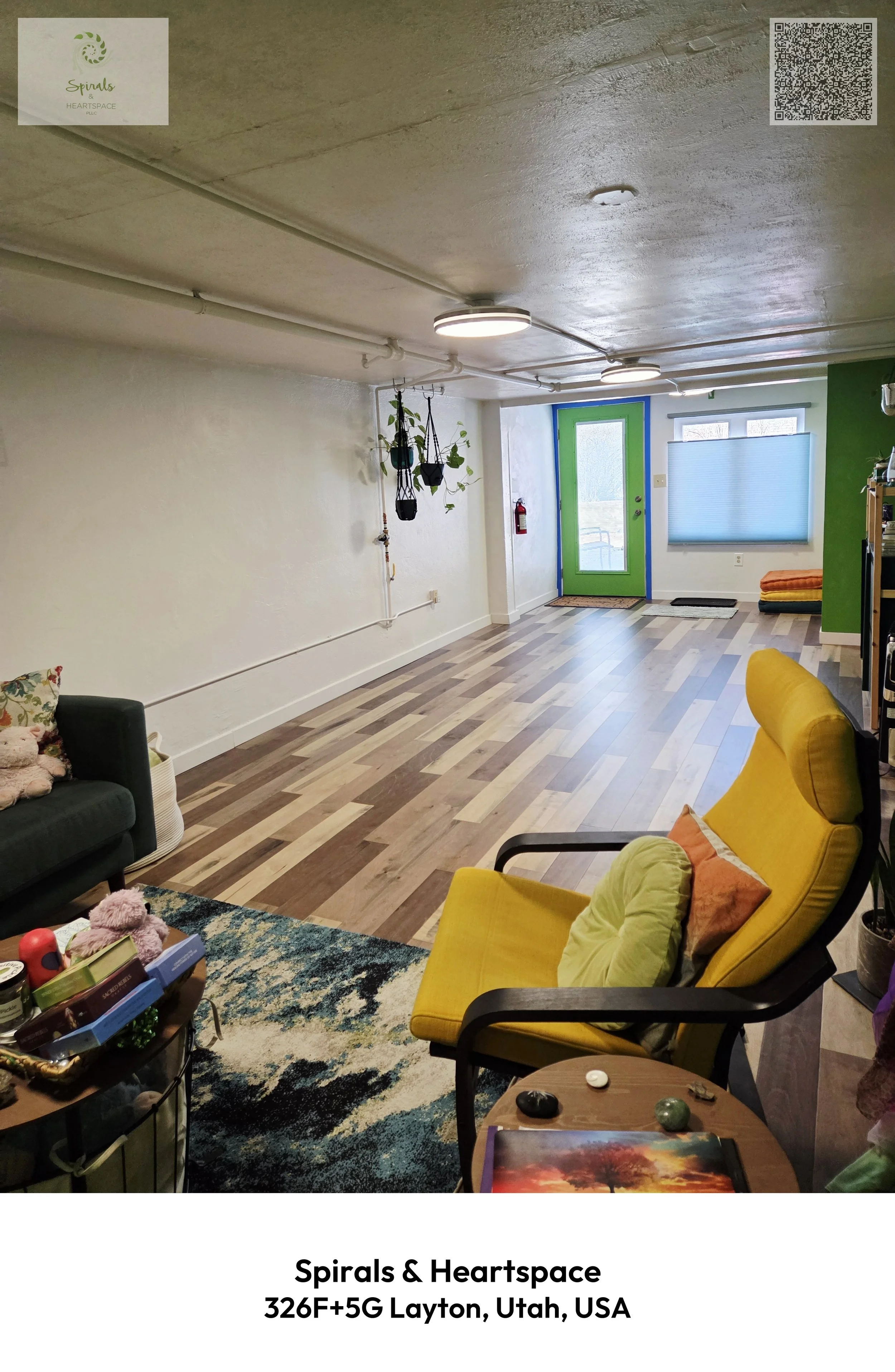
Spirals & Heartspace offers both in-person sessions in Layton and online therapy for clients in Utah.
The practice is locally positioned for clients in Layton, Kaysville, Farmington, Syracuse, Clearfield, Clinton, Roy, Ogden, Bountiful, Davis County, and nearby northern Utah communities.
The office is listed at 534 W Gentile St in Layton, with public listing hours Monday through Friday from 9:30 AM to 7:00 PM.
Prospective clients can call (385) 301-5252 or visit https://spiralsandheartspacehealing.com/ to ask about consultation options, session fit, and scheduling.
The public map listing for Spirals & Heartspace can help clients verify the Gentile Street office before planning an in-person appointment.
Popular Questions About Spirals & Heartspace
What is Spirals & Heartspace?
Spirals & Heartspace is a Layton, Utah psychotherapy and coaching practice offering somatic, trauma-focused, expressive arts, movement-based, and attachment-informed support for adults.
Who is the therapist at Spirals & Heartspace?
The official site identifies Ande Welling as the therapist, coach, movement facilitator, and guide behind Spirals & Heartspace. Listed credentials include LCMHC, BC-DMT, NCC, GL-CMA, BSE, EMDR Trained, and CCTP-II.
Where is Spirals & Heartspace located?
The matching public listing and LinkedIn profile list the address as 534 W Gentile St, Layton, UT 84041.
Does Spirals & Heartspace offer online therapy?
Yes. The official FAQ states that therapy is available in person or through a HIPAA-compliant telehealth platform for clients who live in Utah.
What services does Spirals & Heartspace provide?
Listed services include therapy, coaching, consultation, authentic movement, trauma therapy, somatic therapy, grief counseling, movement therapy, and attachment therapy.
What makes somatic therapy different from traditional talk therapy?
The official Layton page explains that somatic therapy works with body sensations, movement, and physical experience because trauma and emotional patterns can be held in the nervous system, not only in thoughts.
Do clients need dance experience for movement therapy?
No. The official Layton FAQ says no dance training or special physical ability is required, and that movement therapy uses a client’s natural capacity for movement to access emotions and process experiences.
Does Spirals & Heartspace accept insurance?
The official FAQ says the practice does not take insurance directly, but may provide superbills or bill for out-of-network benefits when applicable. Clients should confirm current reimbursement options directly before scheduling.
What are Spirals & Heartspace’s listed hours?
The matching public listing shows Monday through Friday from 9:30 AM to 7:00 PM, with Saturday and Sunday closed. Appointment availability should be confirmed directly.
How can I contact Spirals & Heartspace?
Call (385) 301-5252, visit https://spiralsandheartspacehealing.com/, or use the listed social profiles: https://www.instagram.com/spiralsheartspace/, https://www.linkedin.com/company/spirals-and-heartspace-pllc, https://www.tiktok.com/@spiralsheartspace, https://x.com/SpiralsHea61786, and https://www.youtube.com/@SpiralsHeartspace.
Landmarks Near Layton, UT
Spirals & Heartspace is located on West Gentile Street in Layton, Utah, with in-person therapy available locally and online therapy available for Utah residents. Clients near these landmarks can call (385) 301-5252 or visit https://spiralsandheartspacehealing.com/ to ask about somatic therapy, trauma therapy, movement therapy, grief counseling, attachment therapy, and consultation options.
- 534 W Gentile St — The listed office address for Spirals & Heartspace; clients can use the map listing to verify the office before visiting.
- West Gentile Street — The local street connected with the practice’s Layton office location.
- Downtown Layton — A practical local reference point for clients navigating central Layton.
- Layton Hills Mall — A major Layton shopping landmark and useful orientation point for clients traveling through the city.
- Interstate 15 near Layton — A major northern Utah route that helps clients reach Layton from nearby Davis County communities.
- Layton FrontRunner Station — A transit landmark for clients traveling by commuter rail through Davis County.
- Ellison Park — A local park and community landmark in Layton.
- Great Salt Lake Shorelands Preserve — A major natural landmark west of Layton and a recognizable Davis County destination.
- Hill Air Force Base — A major regional landmark near Layton and Clearfield.
- Kaysville — A nearby Davis County city listed in the practice’s surrounding service area.
- Farmington — A nearby Davis County community included in the broader local service-area language.
- Ogden — A nearby northern Utah city; clients can ask whether online Utah therapy or in-person Layton sessions are the best fit.