Movement Therapy for Mindful Healing and Emotional Release
Movement has always been part of healing, long before it had a clinical name. People pace when they are anxious, rock when they are grieving, stretch after stress, and sway when words fail. The body does not wait for a therapist’s office to begin More helpful hints telling the truth. It signals, braces, protects, reaches, collapses, and recovers. Movement therapy works with that reality rather than against it.
In practice, movement therapy is not about performance, choreography, or getting a workout. It is a therapeutic use of bodily movement to help people notice internal states, regulate the nervous system, access emotions, and release patterns that have become physically and psychologically stuck. Sometimes that looks like guided movement in a quiet room. Sometimes it is as subtle as changing posture, loosening the jaw, pressing the feet into the floor, or experimenting with the distance between one person and another. At its best, movement therapy helps people feel safer in their own bodies, which is often the first condition for meaningful emotional healing.
This matters because many forms of suffering are carried physically. Trauma therapy has taught clinicians to pay close attention to what happens below the level of conscious narrative. Somatic therapy has expanded that understanding by treating bodily sensation as clinically relevant, not incidental. Grief counseling, too, increasingly recognizes that loss is not just a story we tell, but an experience that can constrict breathing, alter gait, flatten energy, and disrupt sleep for months. When movement is brought into treatment with skill and restraint, it can become a practical bridge between feeling overwhelmed and feeling present.
Why the body often speaks first
People often arrive in therapy with language that is accurate but incomplete. They may say they are “fine,” while their shoulders are lifted to their ears. They may describe an argument calmly, while their hands are clenched hard enough to blanch the knuckles. They may insist they are over a breakup, while their chest tightens every time they imagine being alone in the evening. None of that means they are being dishonest. It means the body is tracking a threat, a loss, or an unmet need faster than the verbal mind can organize it.
That is one reason movement therapy can be so effective. It does not require a person to have the perfect explanation before healing begins. A client who cannot yet describe what happened in a traumatic childhood may still notice that they hold their breath when someone stands too close. A bereaved parent may not be ready to talk for an hour, but may be able to explore what happens when they curl inward, then slowly uncurl and let their back touch the chair. A person with relational injuries may discover, through very simple movement experiments, that asking for space feels easier than maintaining eye contact while feeling exposed.
Clinically, these are not small observations. They can reveal protective strategies that once made perfect sense. Freezing, shrinking, fidgeting, leaning away, going rigid, smiling automatically, or becoming overly animated can all be adaptive responses. The goal is not to eliminate them on sight. The goal is to help the person recognize choice. If a response is no longer serving them, the therapist can support a gradual expansion of options.
What movement therapy actually involves
There is no single standardized session format because movement therapy sits at the crossroads of psychotherapy, body awareness, and expressive practice. In some settings, it overlaps with dance/movement psychotherapy. In others, it is folded into somatic therapy, trauma therapy, or attachment therapy. A skilled clinician adapts the approach to the person in front of them, the presenting issue, and the person’s tolerance for bodily awareness.
A typical session might begin with noticing rather than moving. The therapist may ask where the client feels tension, numbness, heat, heaviness, or agitation. The person may be invited to shift weight from one foot to the other, lengthen the spine, or track the impulse to move without forcing action. That restraint matters. Good movement-based work is not about pushing catharsis. It is about titration, the careful pacing that lets someone experience sensation or emotion in manageable doses.
For someone carrying chronic anxiety, a session may focus on containment. The therapist might help them find movements that create a sense of boundary and support, such as pressing palms together, widening their stance, or using a blanket around the shoulders. For someone dealing with grief, movement may center on expression and completion. There may be a chance to reach toward what is gone, to fold around the ache, or to let tears come while the body remains grounded. For clients working through attachment wounds, movement often reveals a great deal about proximity, trust, and self-protection. The simple question of whether one steps forward, back, or sideways in response to another person can carry rich therapeutic meaning.
The connection between movement and emotional release
“Emotional release” is a phrase that gets used loosely, sometimes too loosely. It can suggest a dramatic purge after which everything feels resolved. Real healing is usually less theatrical and more layered. Emotional release through movement often looks like a person exhaling fully for the first time in twenty minutes. It looks like unclenching the belly after years of armoring. It looks like anger finally becoming specific enough to feel in the arms and hands instead of leaking out as generalized irritability. It looks like grief moving from numbness into tears, then into fatigue, then into a surprising sense of spaciousness.
One client I once heard described by a colleague had spent years talking competently about a childhood marked by unpredictability. She knew the facts, understood the family dynamics, and could name every pattern. Yet she still felt detached from herself. In movement-based sessions, what changed first was not her insight but her posture. She noticed that when discussing her mother, she folded her elbows tightly across her ribs and tucked her chin. The therapist did not interpret immediately. Instead, they stayed with the movement. What did those arms want to do if they did not have to stay folded? Over time, the answer became clear. They wanted to push away. That impulse, once felt and enacted safely, opened access to anger she had never believed she was allowed to feel. The emotional release did not come from analysis alone. It came from giving the body a completed action it had been holding for years.
This is where movement therapy can be especially helpful in trauma therapy. Traumatic stress often disrupts natural defensive responses. A person may want to run but freeze instead. They may want to shout but become silent. They may want to protect themselves but feel powerless. Movement work can support the completion of interrupted responses in a controlled setting. That does not erase trauma. It can, however, reduce the sense of internal paralysis and restore a measure of agency.
Mindfulness, but with muscle and breath
Mindfulness is often described as paying attention to the present moment without judgment. For many people, that is a useful practice. For others, especially those with trauma histories, silent internal focus can feel anything but calming. Sitting still and scanning the body may intensify panic, dissociation, or intrusive memories. Movement offers another route into mindful awareness.
A movement-based mindfulness practice gives attention something concrete to land on. The feeling of the feet contacting the floor. The rhythm of a hand tracing the opposite forearm. The shift in temperature when the chest opens and the breath deepens. The change in balance when weight moves into the heels rather than the toes. These are present-moment anchors that can feel more tolerable than abstract meditation instructions.
That practical difference matters. In clinical work, the best mindfulness interventions are not the most elegant, they are the ones a person can actually use when distressed. Someone who cannot sit still for ten minutes may still be able to walk slowly across a room and notice each step. A teenager overwhelmed by anger may not respond to “take a deep breath,” but may tolerate pushing against a wall and tracking the sensation in their arms. A grieving spouse who feels unreal after a funeral may not want guided imagery, but may welcome a hand on the sternum and another on the abdomen while standing barefoot on solid ground.
Mindfulness in movement therapy is not passive observation alone. It includes noticing sensation, action, impulse, and meaning together. That combination can help clients recognize when an emotional state is building before it overtakes them. Over time, that recognition becomes a form of self-trust.
Where grief lives in the body
Grief counseling often begins with conversation because loss changes so much of a person’s inner and outer life. Yet grief also changes the body in unmistakable ways. People report a heavy chest, a hollow stomach, restless legs, back pain, shallow breathing, and a strange sense of moving through wet cement. Some stop exercising entirely. Others become compulsively active because stillness brings them too close to the pain. Both patterns can be understandable.
Movement therapy can help because grief is rhythmic by nature. It comes in waves, often without warning. The body knows this even when the mind wants a neat timeline. I have seen people describe grief as a pressure that needs motion. A walk at dusk. Rocking in a chair. Kneeling on the floor. Stretching the arms overhead and then letting them fall. None of these are trivial gestures. They can be ways the body metabolizes sorrow.
There is also a social dimension. Grief often isolates people, and movement in a therapeutic context can gently restore connection. In some group settings, participants may mirror one another’s simple gestures, creating a felt sense of being accompanied without requiring constant speech. In individual work, the therapist’s attuned pacing matters. If the therapist invites too much activation too soon, the person may shut down. If they stay so cautious that nothing shifts, treatment can become stagnant. Good grief counseling through movement requires sensitivity to timing, stamina, and meaning.
Importantly, grief is Grief counseling not a pathology to be discharged and forgotten. Movement therapy should never be used to pressure someone into “letting go” on a schedule that serves others more than the bereaved. Sometimes the work is not to release grief, but to help someone carry it with less strain.
Trauma, attachment, and the body’s map of safety
Attachment therapy and movement therapy often meet at the question of safety. Early relationships teach the body what closeness feels like. If care was inconsistent, intrusive, frightening, or emotionally absent, a person may carry that learning physically into adult relationships. They may brace when someone is kind. They may lean in too fast, then pull away in shame. They may confuse intensity with connection because calm attention feels unfamiliar.
These patterns are not just beliefs. They show up in timing, posture, gaze, muscle tone, and spatial behavior. One person may speak with ease but never let their back touch the chair. Another may crave reassurance while physically turning away when it is offered. A movement-informed clinician can notice these contradictions without shaming them. The body is often protecting a younger version of the self.
In attachment therapy, movement can help clients explore boundaries and proximity in real time. The therapist might ask, “What happens if you sit a little farther back?” or “How does it feel to keep your feet planted while asking for what you need?” These small experiments can reveal an enormous amount. They also create opportunities for corrective experience. When a client tries a new bodily position and discovers they are still safe, that learning registers more deeply than insight alone.
This is one reason somatic therapy has become such an important companion to relational work. If a client understands intellectually that their partner is not their parent, but their nervous system still reads closeness as danger, talking alone may not be enough. The body needs repeated, tolerable experiences of contact, distance, assertiveness, and settling.
What a well-run session feels like
People are sometimes wary of movement-based treatment because they imagine being asked to dance in front of a stranger. In reality, competent movement therapy is usually much more measured. A good session often feels spacious, collaborative, and surprisingly practical. The therapist checks consent repeatedly, explains why an intervention may help, and adapts when something feels too activating or too vague.
There are a few signs that the work is in good hands:
- The therapist does not force emotional expression or push for dramatic release.
- They offer choices and respect a “no” without argument.
- They can explain how movement relates to your goals, whether that is trauma therapy, grief counseling, or relationship healing.
- They watch for signs of overwhelm, such as dissociation, breath holding, sudden confusion, or collapse in energy.
- They integrate bodily experience with reflection, so the session does not become raw activation without meaning.
That last point is especially important. Movement without integration can leave people stirred up but not supported. The therapeutic value comes from linking sensation, emotion, memory, and choice. A person notices their fists clench when they speak about work. They experiment with pushing outward. They feel anger, then sadness. They realize they have never been allowed to say “stop” without retaliation. Now the movement has become information, not just expression.
A few grounded ways to begin at home
Formal therapy is the right place for deeper work, especially where trauma is involved. Still, some people benefit from simple movement practices that help them reconnect with the body safely between sessions. The emphasis should stay on regulation, not performance.
- Stand with both feet on the floor and slowly shift weight side to side for one minute. Notice which side feels easier to inhabit.
- Press your palms together for five slow breaths, then release and compare the sensation in your chest, shoulders, and jaw.
- Walk at a natural pace for five minutes without your phone, paying attention to the contact of heel, midfoot, and toes.
- Reach both arms forward as if pushing something away, then relax. Repeat three times and notice any emotional change.
- Sit back in a chair and feel what happens when the back is fully supported instead of held upright by effort alone.
None of these practices should cause flooding. If they do, stop, orient to the room, and return to something more external, such as naming objects you can see. People with significant trauma histories often need professional support to work with bodily activation safely. That is not a failure of will. It is a matter of pacing and nervous system capacity.
When movement therapy is especially useful, and when caution matters
Movement therapy can be especially useful for people who say things like, “I understand my pattern, but I still do it,” or “I feel disconnected from my body,” or “I can talk about it, but I cannot feel it.” It often helps individuals with chronic stress, developmental trauma, grief, burnout, relational wounds, and medically unexplained tension patterns. It can also support people who do not naturally process through language, including adolescents and some men who have spent years turning vulnerable emotion into action.
At the same time, there are edge cases that call for care. Not every client benefits from immediate body focus. Some dissociate more when asked to notice internal sensation. Others have medical conditions, chronic pain syndromes, or mobility limitations that require thoughtful adaptation. Some cultural or religious backgrounds shape how movement, touch, and expressive work are understood. A skilled therapist does not treat these as obstacles to bulldoze through. They treat them as essential context.
There is also a trade-off between activation and stability. Too little movement and the session may remain purely conceptual. Too much movement and the person may leave dysregulated. The best clinicians are constantly calibrating, asking not just “What could open this?” but “What can this person metabolize today?” That judgment separates effective somatic therapy from generic body-based exercises.
Healing is often quieter than people expect
When people imagine emotional release, they often picture sobbing, shaking, or a dramatic breakthrough. Those moments can happen. More often, the meaningful shifts are quieter. A client who used to curl inward when discussing conflict sits upright and keeps breathing. A grieving man who felt numb notices tears gathering and does not apologize for them. A woman with a long history of fawning pauses before saying yes, feels her feet, and says she needs time. These are bodily changes, relational changes, and psychological changes all at once.
Movement therapy helps make those moments possible because it honors a basic truth: healing is not only a matter of changing thoughts. It is also a matter of changing patterns of tension, impulse, rhythm, and response. The body has often been carrying the burden long after the conscious mind has run out of language. When mindful movement is brought into therapy with professionalism, patience, and respect, people do not simply express emotion. They learn how to feel without being overtaken, how to protect themselves without disappearing, and how to inhabit their lives with more steadiness.
That is the real promise of movement therapy. Not spectacle. Not forced catharsis. A gradual return to embodied choice, which is where durable healing often begins.
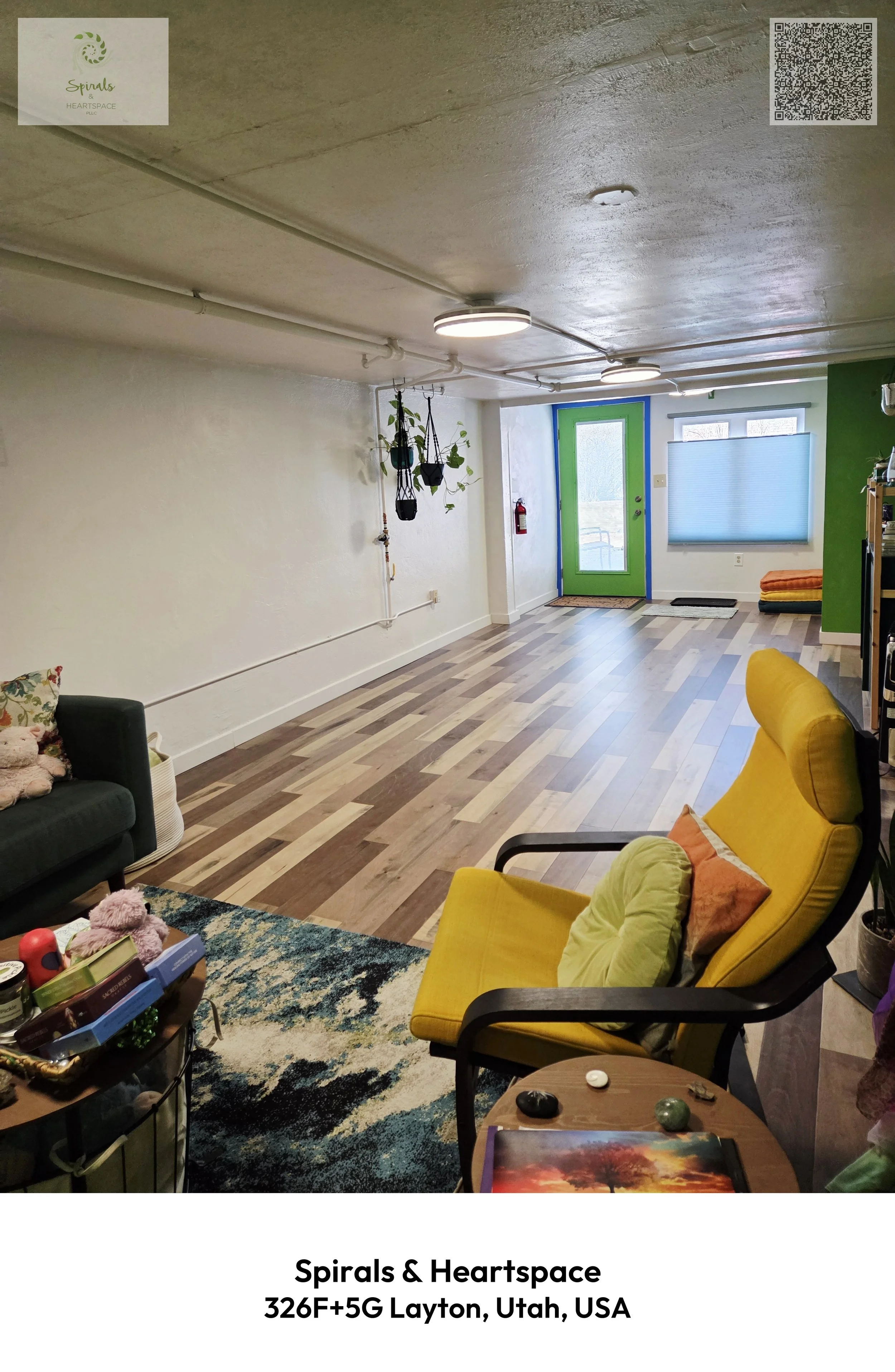
Spirals & Heartspace
Name: Spirals & Heartspace
Address: 534 W Gentile St, Layton, UT 84041
Phone: (385) 301-5252
Website: https://spiralsandheartspacehealing.com/
Hours:
Sunday: Closed
Monday: 9:30 AM – 7:00 PM
Tuesday: 9:30 AM – 7:00 PM
Wednesday: 9:30 AM – 7:00 PM
Thursday: 9:30 AM – 7:00 PM
Friday: 9:30 AM – 7:00 PM
Saturday: Closed
Open-location code / plus code: 326F+5G Layton, Utah, USA
Coordinates: 41.0604503, -111.9762128
Map/listing URL: https://www.google.com/maps/place/Spirals+%26+Heartspace/@41.0604503,-111.9762128,766m/data=!3m2!1e3!4b1!4m6!3m5!1s0x875303311f1d4d1b:0xc6859e5e3fceafe2!8m2!3d41.0604503!4d-111.9762128!16s%2Fg%2F11x781dbvb
Embed iframe:
Socials:
Instagram: https://www.instagram.com/spiralsheartspace/
LinkedIn: https://www.linkedin.com/company/spirals-and-heartspace-pllc
TikTok: https://www.tiktok.com/@spiralsheartspace
X: https://x.com/SpiralsHea61786
YouTube: https://www.youtube.com/@SpiralsHeartspace
The practice is led by Ande Welling, a licensed clinical mental health counselor with training in dance/movement therapy, somatic work, EMDR, trauma care, relational neuroscience, and embodied attachment.
Listed services include therapy, coaching, consultation, authentic movement, trauma therapy, somatic therapy, grief counseling, movement therapy, and attachment therapy.
The practice serves adults who want a deeper body-aware approach to trauma, anxiety, depression, grief, burnout, self-abandonment, family patterns, and relationship wounds.
Spirals & Heartspace offers both in-person sessions in Layton and online therapy for clients in Utah.
The practice is locally positioned for clients in Layton, Kaysville, Farmington, Syracuse, Clearfield, Clinton, Roy, Ogden, Bountiful, Davis County, and nearby northern Utah communities.
The office is listed at 534 W Gentile St in Layton, with public listing hours Monday through Friday from 9:30 AM to 7:00 PM.
Prospective clients can call (385) 301-5252 or visit https://spiralsandheartspacehealing.com/ to ask about consultation options, session fit, and scheduling.
The public map listing for Spirals & Heartspace can help clients verify the Gentile Street office before planning an in-person appointment.
Popular Questions About Spirals & Heartspace
What is Spirals & Heartspace?
Spirals & Heartspace is a Layton, Utah psychotherapy and coaching practice offering somatic, trauma-focused, expressive arts, movement-based, and attachment-informed support for adults.
Who is the therapist at Spirals & Heartspace?
The official site identifies Ande Welling as the therapist, coach, movement facilitator, and guide behind Spirals & Heartspace. Listed credentials include LCMHC, BC-DMT, NCC, GL-CMA, BSE, EMDR Trained, and CCTP-II.
Where is Spirals & Heartspace located?
The matching public listing and LinkedIn profile list the address as 534 W Gentile St, Layton, UT 84041.
Does Spirals & Heartspace offer online therapy?
Yes. The official FAQ states that therapy is available in person or through a HIPAA-compliant telehealth platform for clients who live in Utah.
What services does Spirals & Heartspace provide?
Listed services include therapy, coaching, consultation, authentic movement, trauma therapy, somatic therapy, grief counseling, movement therapy, and attachment therapy.
What makes somatic therapy different from traditional talk therapy?
The official Layton page explains that somatic therapy works with body sensations, movement, and physical experience because trauma and emotional patterns can be held in the nervous system, not only in thoughts.
Do clients need dance experience for movement therapy?
No. The official Layton FAQ says no dance training or special physical ability is required, and that movement therapy uses a client’s natural capacity for movement to access emotions and process experiences.
Does Spirals & Heartspace accept insurance?
The official FAQ says the practice does not take insurance directly, but may provide superbills or bill for out-of-network benefits when applicable. Clients should confirm current reimbursement options directly before scheduling.
What are Spirals & Heartspace’s listed hours?
The matching public listing shows Monday through Friday from 9:30 AM to 7:00 PM, with Saturday and Sunday closed. Appointment availability should be confirmed directly.
How can I contact Spirals & Heartspace?
Call (385) 301-5252, visit https://spiralsandheartspacehealing.com/, or use the listed social profiles: https://www.instagram.com/spiralsheartspace/, https://www.linkedin.com/company/spirals-and-heartspace-pllc, https://www.tiktok.com/@spiralsheartspace, https://x.com/SpiralsHea61786, and https://www.youtube.com/@SpiralsHeartspace.
Landmarks Near Layton, UT
Spirals & Heartspace is located on West Gentile Street in Layton, Utah, with in-person therapy available locally and online therapy available for Utah residents. Clients near these landmarks can call (385) 301-5252 or visit https://spiralsandheartspacehealing.com/ to ask about somatic therapy, trauma therapy, movement therapy, grief counseling, attachment therapy, and consultation options.
- 534 W Gentile St — The listed office address for Spirals & Heartspace; clients can use the map listing to verify the office before visiting.
- West Gentile Street — The local street connected with the practice’s Layton office location.
- Downtown Layton — A practical local reference point for clients navigating central Layton.
- Layton Hills Mall — A major Layton shopping landmark and useful orientation point for clients traveling through the city.
- Interstate 15 near Layton — A major northern Utah route that helps clients reach Layton from nearby Davis County communities.
- Layton FrontRunner Station — A transit landmark for clients traveling by commuter rail through Davis County.
- Ellison Park — A local park and community landmark in Layton.
- Great Salt Lake Shorelands Preserve — A major natural landmark west of Layton and a recognizable Davis County destination.
- Hill Air Force Base — A major regional landmark near Layton and Clearfield.
- Kaysville — A nearby Davis County city listed in the practice’s surrounding service area.
- Farmington — A nearby Davis County community included in the broader local service-area language.
- Ogden — A nearby northern Utah city; clients can ask whether online Utah therapy or in-person Layton sessions are the best fit.