Movement Therapy for Trauma, Stress, and Emotional Expression
There are moments in clinical work when language simply stops carrying the weight of a person’s experience. A client can describe panic in perfect detail and still feel trapped by it. Another can narrate a painful childhood with remarkable clarity, yet remain cut off from anger, grief, or relief. This is often where movement therapy becomes especially valuable. It gives the body a way to participate in healing, not as an accessory to talk therapy, but as a primary source of information and change.
Trauma is not stored as a story alone. It is also held in muscle tension, posture, breath, impulses that were interrupted, and patterns of bracing that long outlived the original danger. Stress behaves similarly. People often notice it first in their shoulders, jaw, chest, digestion, or sleep before they can make sense of it cognitively. Emotional expression is shaped the same way. Many adults learned early, often in subtle and repeated ways, which feelings were safe to show and which had to be swallowed, hidden, or performed differently. The body adapts, then keeps adapting, sometimes for decades.
Movement therapy works with that reality. It is not simply exercise, dance, or relaxation. At its best, it is a structured, attuned, clinically grounded process that helps people notice, tolerate, and reorganize internal experience through movement, sensation, rhythm, breath, and relational presence. For some clients, this becomes a missing bridge between insight and change.
Why movement matters when trauma lives in the body
Trauma therapy has evolved significantly over the past few decades, in part because clinicians have become better at recognizing that traumatic stress disrupts the nervous system as much as it disrupts memory. A person may know they are safe in the present and still react as if threat is immediate. Their heart races, limbs go cold, thoughts narrow, and speech becomes either pressured or unavailable. This is not a failure of willpower. It is the body doing what it learned to do.
Movement gives access to these trauma responses in a way words often cannot. Consider a client who freezes whenever conflict arises. In conversation, she may say, “I shut down.” That phrase is accurate, but it is also broad. When asked to notice what happens physically, she may realize her knees lock, her breath becomes shallow, and her gaze drops. If movement is introduced gently, perhaps shifting weight from one foot to the other, softening the knees, or rehearsing the act of stepping back, the nervous system starts to experience options where there used to be only collapse or immobility.
That kind of work is not dramatic from the outside. In fact, the most meaningful progress is often subtle. A client who could not feel his feet on the floor starts noticing pressure through the heels. Someone who habitually curls inward begins to tolerate sitting with a little more space in the chest. Another person practices reaching an arm out and discovers that the movement evokes fear, sadness, and then a surprising sense of agency. These moments matter because they shift experience from abstraction to lived reality.
Somatic therapy and movement therapy overlap substantially here. Both are concerned with how emotion, memory, and survival responses show up in the body. Not every somatic therapy approach uses overt movement, and not every movement-based intervention is trauma informed. The distinction matters. Trauma-sensitive movement is paced carefully, collaborative, and deeply respectful of choice. It does not push for catharsis. It does not assume bigger expression is always better. In many cases, the therapeutic task is helping a client do less, more safely, and with more awareness.
The body’s protective intelligence
One of the most important reframes in this work is that symptoms often make sense. Tight shoulders, numbness, overactivity, restlessness, and difficulty crying are not random defects. They are adaptations. At some point, they served a purpose. A child who learns to stay very still in an unpredictable home may grow into an adult who struggles to move freely when upset. A person who had to stay cheerful to maintain connection may smile while describing profound grief. Someone who endured repeated violation may live with chronic vigilance in the hips, abdomen, or throat.
When clients understand this, shame often softens. Their body is not betraying them. It is continuing an old job.
Movement therapy can help update that job. Through repetition and attunement, people begin to notice the difference between protective tension and present-moment necessity. They learn what activation feels like before it becomes overwhelming. They practice transitions, from stillness to movement, contraction to expansion, avoidance to contact, collapse to supported effort. These are not merely physical shifts. They are emotional and relational ones.
A man I once observed in a movement-based trauma group spent weeks barely moving his upper body. He walked into the room with a rigid neck and arms held close to his sides. He had survived years of interpersonal violence and found eye contact nearly intolerable. The early work was simple: tracking breath, noticing weight, experimenting with tiny arm movements that he could stop at any time. Around the sixth session, during a partner exercise that involved mirroring hand gestures from a comfortable distance, he lifted both hands chest-high and then laughed, embarrassed and surprised. “That feels huge,” he said. It was huge. Not because of the movement itself, but because his nervous system was risking visibility without immediate threat.
That is often how progress looks in movement therapy. Not cinematic breakthroughs, but increased capacity.
Stress changes movement, and movement changes stress
Stress is sometimes treated as if it exists only in the mind, as a schedule problem, an attitude problem, or a time-management problem. Real life is more complicated. Many people under chronic stress move through the day as if their body is an inconvenience. They rush, brace, hunch, clench, and ignore signals until symptoms become impossible to overlook.
A stressed body tends to narrow its range. Breathing becomes higher in the chest. The rib cage may stop moving fully. Stride length shortens. Arms swing less. Facial expression flattens or hardens. Some people speed up and lose precision. Others become sluggish and heavy. These patterns influence mood and attention, which in turn influence relationships and performance. It is a loop.
Movement therapy interrupts that loop by introducing mindful, purposeful motion. The goal is not just to “burn off” stress. That can help, but it is not the whole picture. The deeper aim is regulation, helping the person notice intensity, track sensation, and recover flexibility in body and mind.
For one client, that might mean rhythmic walking with deliberate attention to footfall and breath. For another, it may mean guided movement that alternates between effort and rest. For someone with high anxiety, swaying, pushing against a wall, or slow spiraling through the spine can be more regulating than seated meditation, which may feel too still or too exposing. The right intervention depends on the person’s history, current state, and tolerance for internal experience.
This is one reason movement therapy can be effective for people who have tried standard stress reduction strategies and felt worse. If sitting quietly with their thoughts sends them into panic or dissociation, asking them to meditate for twenty minutes may not be wise. Starting with movement can create enough safety and grounding to make stillness possible later.
Emotional expression is not only verbal
Many adults can label emotion intellectually but cannot embody it. They say they are sad, but their body remains rigid and dry. They say they are angry, but the statement comes out flat, with no sense of force or boundary. Others feel emotions intensely but cannot modulate them. Once grief or fear arrives, it floods the whole system.
Movement therapy helps build the missing link between feeling and expression. This can happen through posture, gesture, rhythm, spatial awareness, and relational movement. A therapist might invite a client to show what frustration looks like in the hands, then notice whether the movement wants to push, shake, reach, or strike. Another might explore how grief appears in the spine, eyes, or breath, without forcing tears or a narrative. Sometimes the therapeutic shift comes when a person discovers a movement that matches an emotion they have never fully allowed themselves to feel.
Grief counseling can benefit from this approach in particular. Grief is rarely neat, and it is rarely only cognitive. People may feel the absence of a loved one as a heaviness in the sternum, weakness in the legs, or a hollow sensation in the belly. They may also inhibit grief because they fear it will not stop once it starts. Gentle movement can help titrate the experience. A client may rock, fold and unfold, walk while speaking to the person they lost, or make simple gestures of reaching and releasing. These acts can be profoundly organizing. They give shape to what otherwise feels formless.
There is also a place for pleasure, vitality, and play. Trauma treatment sometimes becomes so focused on symptom reduction that people forget healing also involves reclaiming spontaneity. A person who begins to move with curiosity instead of solely with caution is often re-entering life, not just reducing distress.
Movement therapy and attachment
Attachment therapy and movement therapy may seem like separate domains, but in practice they often intersect. Early attachment experiences shape the body. Before children understand language, they learn relationship through rhythm, tone, proximity, gaze, touch, and co-regulation. They learn whether movement toward another person brings comfort, intrusion, neglect, unpredictability, or delight.
Adults carry these attachment templates physically. Some lean bereavement counseling in quickly and then feel engulfed. Some hold distance even when they want closeness. Some cannot track their own boundaries until they are already overwhelmed. In a movement-based clinical setting, these patterns become visible in useful ways. How does a client respond when invited to mirror another person’s movement? Do they speed up to match, hesitate, disappear, overperform, retreat, or become hypervigilant? What happens if the therapist shifts distance slightly, or asks the client to choose the pace?
These are not party games. They are windows into procedural memory, the deeply learned patterns that organize relationship outside conscious thought.
In skilled hands, movement can support corrective relational experiences. A therapist who offers clear structure, consistent pacing, and respect for choice helps the client experience connection without coercion. Simple exercises involving synchrony, such as matching breathing pace or taking turns leading and following movement, can reveal a great deal about trust, control, and responsiveness. For some clients, being followed accurately without being overtaken is profoundly regulating. For others, leading a movement and watching someone else honor it without judgment touches old wounds around invisibility or helplessness.
This is one reason movement therapy should not be mistaken for generic wellness programming. The therapeutic frame matters. The relationship matters. The clinician’s ability to track activation, dissociation, shame, and attachment dynamics matters a great deal.
What a session can actually look like
People often imagine movement therapy as either interpretive dance or intense emotional release. Most sessions are neither. They are usually quieter, more structured, and more practical than people expect.
A typical session may begin with orienting to the room, noticing contact with the chair or floor, and checking internal state. From there, the therapist might introduce small movements, perhaps of the head, shoulders, hands, or feet, and ask the client to notice sensation, impulse, and emotion. Sometimes there is music, but not always. Sometimes the client moves standing up, sometimes seated, and sometimes only imagines movement if actual motion feels too activating.
The work is often cyclical. A client explores a movement, notices what emerges, pauses, reflects, and then chooses whether to continue, shift, or stop. Language is still used, but it is used in service of embodied awareness rather than in place of it.
Some interventions are especially common:
- Grounding through weight, pressure, and contact with surfaces
- Boundary work using pushing, reaching, or stepping back
- Rhythm-based regulation with walking, tapping, or swaying
- Expressive exploration of shape, gesture, and posture
- Integration through reflection, journaling, or brief verbal processing
That does not mean every client needs all of these. Someone with a history of assault may find reaching movements empowering, while another may find them overwhelming until more stabilization is in place. A grieving client may respond well to repetitive rocking, whereas a highly dissociative client might need stronger sensory input and more external orientation.
Good movement therapy is responsive rather than formulaic.
When movement helps, and when it needs modification
Movement-based work can be remarkably effective, but it is not universally appropriate in the same way or at the same time. This is where clinical judgment matters.
For clients with complex trauma, rapid activation without adequate containment can backfire. Inviting large expressive movement too early may increase flooding, shame, or dissociation. For people with chronic pain, certain interventions need adaptation so that the therapy does not become another setting where they feel pressured to override bodily limits. Clients with eating disorders may need careful framing, because any body-based intervention can be misread through a lens of control, punishment, or appearance. Those with psychosis, severe dissociation, or unstable medical conditions may also require a modified or multidisciplinary approach.
There are practical considerations as well. Some people come from cultural or family backgrounds where expressive movement feels unfamiliar, exposed, or even unsafe. Others have physical disabilities, injuries, or neurodivergent sensory profiles that change what movement feels like. None of this rules the work out. It simply means the therapist must adapt and collaborate rather than assume.
A few signs that movement therapy should proceed slowly, with strong structure, are worth noting:
- The client loses time, blanks out, or becomes highly foggy under stress
- Bodily sensations trigger immediate panic or disgust
- Movement evokes shame so intense that the person wants to flee or appease
- There is a history of coercion around touch, performance, or bodily control
- The client struggles to identify when to stop, rest, or ask for space
These are not disqualifiers. They are cues for pacing. In experienced trauma therapy, going slowly is not avoidance. It is precision.
The role of consent, pacing, and choice
If there is one principle that separates healing movement work from potentially harmful movement work, it is consent. Trauma often involves loss of control. Therapy should not recreate that dynamic, even subtly.
Consent in this context means more than asking whether a client is willing to try an exercise. It means building a process where the client can modify, decline, pause, or stop without penalty. It means naming what is happening, explaining why a particular intervention is being offered, and staying alert to nonverbal signs that the person’s nervous system is no longer engaged in a productive way.
Choice also supports agency. A therapist might ask, “Would you rather explore this standing or seated?” or “Do you want to make the movement larger, smaller, or keep it in imagination only?” These are small questions, but they matter. They help the client practice noticing preference and acting on it, which is deeply reparative for many trauma survivors.
Pacing is equally important. Some of the most effective sessions involve very little movement because the therapist is helping the client build tolerance in tiny increments. Ten seconds of grounded, conscious pushing with the hands against a wall may accomplish more than twenty minutes of expressive movement that leaves the person disorganized. Bigger is not better. Integrated is better.
How movement therapy fits with other approaches
Movement therapy is rarely best understood as a standalone cure. It often works most effectively as part of a broader treatment plan. A client may combine it with individual trauma therapy, somatic therapy, grief counseling, medication support, or group work. Someone dealing with attachment wounds may use movement-based sessions alongside attachment therapy focused on relational patterns and emotional repair. Another may benefit from movement work while also receiving practical support for sleep, substance use, or life stressors.
This integrated approach reflects clinical reality. Trauma affects many systems at once. It touches body, mind, relationships, identity, work, sexuality, and spiritual life. No single modality reaches everything.
That said, movement can often unlock stalled treatment. Clients who have spent years understanding their patterns without feeling different sometimes discover that the body is where change was waiting. Once they can sense a boundary, complete an interrupted defensive response, or feel emotion without being swallowed by it, talk therapy often deepens. Insight becomes embodied rather than merely observed.
Choosing a qualified practitioner
The popularity of body-based healing has created both opportunity and confusion. Not everyone offering movement-centered work has training in trauma. Some are excellent movement teachers but not equipped to handle flashbacks, dissociation, attachment ruptures, or grief reactions. Others have clinical skills but limited understanding of how movement affects different bodies and histories.
A qualified practitioner should be able to explain their training, how they think about trauma, and what they do when a client becomes overwhelmed. They should be comfortable with modification, clear about boundaries, and attentive to cultural, medical, and accessibility concerns. If touch is ever part of the work, it should be explicit, optional, and handled with exceptional care. Many strong practitioners do profound work without touch at all.
It is also reasonable for clients to ask practical questions. What does a first session look like? Is there verbal processing or mostly movement? How do you work with panic, numbness, or shame? Have you worked with grief, attachment injuries, or complex trauma before? A good therapist will not be defensive about these questions. They will welcome them.
Healing often begins with very small motions
One of the most humbling truths in this field is that profound Grief counseling change often starts in movements so small they could be missed by an untrained eye. A fuller exhale. A hand that uncurls. A head that turns toward the door and then back again. Knees that unlock after years of bracing. A client who says, “I think I want to step back,” and then actually does.
These shifts matter because they restore options. Trauma narrows. Chronic stress narrows. Unexpressed emotion narrows. Movement therapy, done carefully, widens the field. It helps people feel more than one possibility in their body at a time. They can tense and then release. Reach and then retract. Approach and then pause. Grieve without disappearing. Feel anger without becoming violence. Be seen without losing themselves.
That is the deeper promise of this work. Not performance. Not forced catharsis. Not a prettier version of coping. Real flexibility, in the nervous system, in emotional life, and in relationship.
For people whose experiences were shaped by danger, silence, loss, or disconnection, that flexibility can feel revolutionary. It arrives not through abstract ideas alone, but through repeated embodied moments of safety, choice, and expression. Over time, those moments accumulate. The body learns something new. And when the body learns, life often begins to open in places that words could never quite reach.
Spirals & Heartspace
Name: Spirals & Heartspace
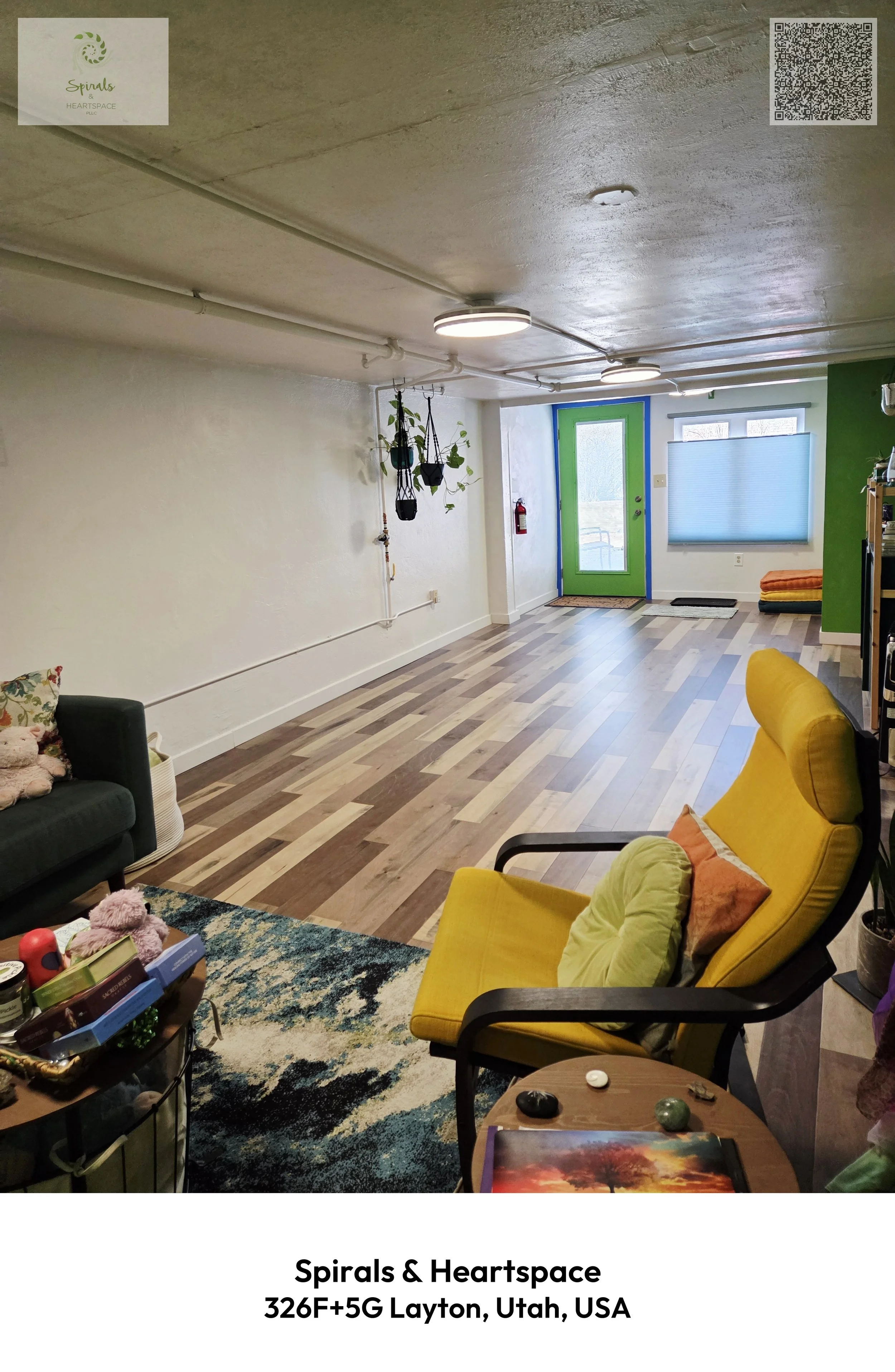
Address: 534 W Gentile St, Layton, UT 84041
Phone: (385) 301-5252
Website: https://spiralsandheartspacehealing.com/
Hours:
Sunday: Closed
Monday: 9:30 AM – 7:00 PM
Tuesday: 9:30 AM – 7:00 PM
Wednesday: 9:30 AM – 7:00 PM
Thursday: 9:30 AM – 7:00 PM
Friday: 9:30 AM – 7:00 PM
Saturday: Closed
Open-location code / plus code: 326F+5G Layton, Utah, USA
Coordinates: 41.0604503, -111.9762128
Map/listing URL: https://www.google.com/maps/place/Spirals+%26+Heartspace/@41.0604503,-111.9762128,766m/data=!3m2!1e3!4b1!4m6!3m5!1s0x875303311f1d4d1b:0xc6859e5e3fceafe2!8m2!3d41.0604503!4d-111.9762128!16s%2Fg%2F11x781dbvb
Embed iframe:
Socials:
Instagram: https://www.instagram.com/spiralsheartspace/
LinkedIn: https://www.linkedin.com/company/spirals-and-heartspace-pllc
TikTok: https://www.tiktok.com/@spiralsheartspace
X: https://x.com/SpiralsHea61786
YouTube: https://www.youtube.com/@SpiralsHeartspace
The practice is led by Ande Welling, a licensed clinical mental health counselor with training in dance/movement therapy, somatic work, EMDR, trauma care, relational neuroscience, and embodied attachment.
Listed services include therapy, coaching, consultation, authentic movement, trauma therapy, somatic therapy, grief counseling, movement therapy, and attachment therapy.
The practice serves adults who want a deeper body-aware approach to trauma, anxiety, depression, grief, burnout, self-abandonment, family patterns, and relationship wounds.
Spirals & Heartspace offers both in-person sessions in Layton and online therapy for clients in Utah.
The practice is locally positioned for clients in Layton, Kaysville, Farmington, Syracuse, Clearfield, Clinton, Roy, Ogden, Bountiful, Davis County, and nearby northern Utah communities.
The office is listed at 534 W Gentile St in Layton, with public listing hours Monday through Friday from 9:30 AM to 7:00 PM.
Prospective clients can call (385) 301-5252 or visit https://spiralsandheartspacehealing.com/ to ask about consultation options, session fit, and scheduling.
The public map listing for Spirals & Heartspace can help clients verify the Gentile Street office before planning an in-person appointment.
Popular Questions About Spirals & Heartspace
What is Spirals & Heartspace?
Spirals & Heartspace is a Layton, Utah psychotherapy and coaching practice offering somatic, trauma-focused, expressive arts, movement-based, and attachment-informed support for adults.
Who is the therapist at Spirals & Heartspace?
The official site identifies Ande Welling as the therapist, coach, movement facilitator, and guide behind Spirals & Heartspace. Listed credentials include LCMHC, BC-DMT, NCC, GL-CMA, BSE, EMDR Trained, and CCTP-II.
Where is Spirals & Heartspace located?
The matching public listing and LinkedIn profile list the address as 534 W Gentile St, Layton, UT 84041.
Does Spirals & Heartspace offer online therapy?
Yes. The official FAQ states that therapy is available in person or through a HIPAA-compliant telehealth platform for clients who live in Utah.
What services does Spirals & Heartspace provide?
Listed services include therapy, coaching, consultation, authentic movement, trauma therapy, somatic therapy, grief counseling, movement therapy, and attachment therapy.
What makes somatic therapy different from traditional talk therapy?
The official Layton page explains that somatic therapy works with body sensations, movement, and physical experience because trauma and emotional patterns can be held in the nervous system, not only in thoughts.
Do clients need dance experience for movement therapy?
No. The official Layton FAQ says no dance training or special physical ability is required, and that movement therapy uses a client’s natural capacity for movement to access emotions and process experiences.
Does Spirals & Heartspace accept insurance?
The official FAQ says the practice does not take insurance directly, but may provide superbills or bill for out-of-network benefits when applicable. Clients should confirm current reimbursement options directly before scheduling.
What are Spirals & Heartspace’s listed hours?
The matching public listing shows Monday through Friday from 9:30 AM to 7:00 PM, with Saturday and Sunday closed. Appointment availability should be confirmed directly.
How can I contact Spirals & Heartspace?
Call (385) 301-5252, visit https://spiralsandheartspacehealing.com/, or use the listed social profiles: https://www.instagram.com/spiralsheartspace/, https://www.linkedin.com/company/spirals-and-heartspace-pllc, https://www.tiktok.com/@spiralsheartspace, https://x.com/SpiralsHea61786, and https://www.youtube.com/@SpiralsHeartspace.
Landmarks Near Layton, UT
Spirals & Heartspace is located on West Gentile Street in Layton, Utah, with in-person therapy available locally and online therapy available for Utah residents. Clients near these landmarks can call (385) 301-5252 or visit https://spiralsandheartspacehealing.com/ to ask about somatic therapy, trauma therapy, movement therapy, grief counseling, attachment therapy, and consultation options.
- 534 W Gentile St — The listed office address for Spirals & Heartspace; clients can use the map listing to verify the office before visiting.
- West Gentile Street — The local street connected with the practice’s Layton office location.
- Downtown Layton — A practical local reference point for clients navigating central Layton.
- Layton Hills Mall — A major Layton shopping landmark and useful orientation point for clients traveling through the city.
- Interstate 15 near Layton — A major northern Utah route that helps clients reach Layton from nearby Davis County communities.
- Layton FrontRunner Station — A transit landmark for clients traveling by commuter rail through Davis County.
- Ellison Park — A local park and community landmark in Layton.
- Great Salt Lake Shorelands Preserve — A major natural landmark west of Layton and a recognizable Davis County destination.
- Hill Air Force Base — A major regional landmark near Layton and Clearfield.
- Kaysville — A nearby Davis County city listed in the practice’s surrounding service area.
- Farmington — A nearby Davis County community included in the broader local service-area language.
- Ogden — A nearby northern Utah city; clients can ask whether online Utah therapy or in-person Layton sessions are the best fit.